Sunday, April 3, 2011

Persuasion


Words and pictures can really get the point across.


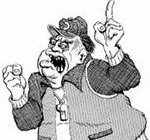
I’ve been thinking about persuasion lately. Not the plaid-jacketed, fender-pounding used car salesman variety, but writing as if you mean it.


As we get busier and time becomes more precious, I continue to realize that everything we write should be clear, to the point, and purposeful.


Otherwise we are wasting our time writing and wasting the time of our readers as well.


There is so much bad writing out there - good for us, I suppose because it keeps us in business - but everywhere you look you will find passive voice, unnecessary words, confused organization, and ignorance of the basics of memorable, persuasive writing.


Bad writing makes us want to read less, and that’s too bad.


So, in this post, I’ve included three good books on writing memorably and persuasively.


Check them out or talk to us - because good writing is good for everyone.


Everything you write should have some element of persuasion - to believe facts, to take action, etc. If not, why are you writing in the first place?


Over the years, I’ve assembled ideas from several people on how to write more persuasively. After all - that should be one of your purposes every time you start to write - whether its a memo, a report, a brochure, a letter - everything you write.


Ever wonder why jokes and urban myths are so easy to remember? Because they are sticky.


Stickiness is when your writing is memorable and Chip and Dan Heath recommend six powerful techniques to help make that happen:

1. Simple

2. Unexpected

3. Concrete

4. Credible

5. Emotional

6. Storied


With lots of examples and some good solid reasoning, all of us can learn to write more memorably.


The North American guru of persuasion is Dr. Robert Cialdini.

Once you get by the tackiness of his book covers, you will find some incredibly useful information.


For example, the one persuasive technique we all try to use - logic- is absolutely the weakest of the ten identified persuasive methods and is probably a waste of time unless you are writing a scientific paper.


Cialdini talks about seven persuasive techniques:

1. Gratitude

2. Because

3. Imitation

4. Likability

5. Authority

6. Shortage

7. Repetition


and I add three more:

8. Logic

9. Reason

10. Credibility.


All can be used to to make your writing more powerful.


Finally, the power of stories to mobilize, excite, and persuade has been recognized by many different authors, foremost among them is Steve Denning.


In this one book, Denning describes how to use stories to meet the most important leadership challenges of today, including motivating others to action, building trust, transmitting values, getting others working together, and sharing knowledge.


If you want your writing to have more impact, buy these books and follow their advice, or check out our workshop on Writing Irresistibly.


We would be glad to work with you.


Contact us at moorepartners@gmail.com if you have any questions.

Wednesday, January 12, 2011

Writing Numbers

Most writers chose this profession because our word skills were greater than our mathematical abilities. Nevertheless, numbers in our business are important.


Here are some of the conventional guidelines:


1) Numbers nine and below are written in words: seven


2) Numbers 10 and above are written in figures: 17


3) The above two rules hold for cardinal (seven, 17), ordinal (seventh, 17th), and centuries (seventh century, 17th century).


4) The simplest way to express large numbers is best. Round numbers are usually spelled out. Be careful to be consistent within a sentence.


You can earn from one million to five million dollars.

You can earn from five hundred to five million dollars.


5) Money is preceded by a dollar sign even though it is read in a different order:


$17 million (17 million dollars)

You can earn from $5 hundred to $5 million.


6) Be consistent within a category. For example, if you choose numerals because one of the numbers you must deal with is greater than ten, you should use numerals for everything in that category.


Given the budget constraints, if all 30 history students attend the four plays, then the 7 math students will be able to attend only two plays.


(Students are represented with figures; plays are represented with words.)

My 10 cats fought with their 2 cats.

My ten cats fought with their two cats.


7) Always spell out simple fractions and use hyphens with them.


One-half of the pies have been eaten.

A two-thirds majority is required for amendments to the club constitution.


8) A mixed fraction can be expressed in figures unless it is the first word of a sentence.


We expect a 5 ½ per cent wage increase.

Five and one-half per cent was the maximum allowable interest.


9) With numbers of four or more digits, use commas. Commas are to the right of the thousands and millions places, continue placing commas after every three places.


465
1,465
11,465
111,465

10)Use noon and midnight rather than 12:00 P.M. and 12:00 A.M., no one knows what they mean.


11) Write out a number if it begins a sentence.


Seventeen blue jays baked in a cake.

Twenty-nine people won an award for helping their communities.


You can express decades in complete numerals and you don’t need an apostrophe between the year and the s.


The Canadian economy grew during the 1980s and 1990s.


Contact us at moorepartners@gmail.com if you have any questions.

Sunday, May 16, 2010

Crazy Names for Bottles of Wine


Adapted from Michael Quinion, World Wide Words

You may have heard those odd names for big bottles of wine such as Magnum, Jeroboam, Rehoboam, and Methuselah.

What do they mean and where do they come from? How long does wine have to age for it to be called a Methuselah?

I'm glad to be able to report that the age of the wine has no connection with these curious names, otherwise a methuselah would have age for 969 years.

Those crazy names refer to the sizes of the bottle, but it's now illegal to put any of them except one on a bottle and they've become curiosities that mainly come up in pub quizzes.

The only term of the set that's still allowed is "magnum", which refers to a bottle containing two standard bottles or 1.5 litres. It's also the oldest of all the terms, having appeared in English in one of the prose works of the Scots poet Robert Burns, back in 1788.

It's an abbreviation of Latin "magnum bonum", a large good thing. It was in Scotland that it acquired the sense of a size of wine bottle and became abbreviated to "magnum". It has also been given to a variety of potato, various varieties of cooking plums, a gun, and even a large-barrelled steel pen.

The remainder of the set, as usually quoted in reference books, are jeroboam (4 bottles/3 litres), rehoboam (6/4.5), methuselah (8/6), salmanazar (12/9), balthazar (16/12), nebuchadnezzar (20/15), melchior (24/18), solomon (28/21), sovereign (33.3/25), and primat (36/27).

Some lists even include a melchizedek, holding 40 standard bottles or 30 litres.

For more, go to Moore Partners Scribbles


The Art of Being Clear


The Art of Being Clear


We planned to construct a dumbwaiter in the new house we are building. The idea of getting coffee, tea, and snacks up to our second floor office with-out spilling all over ourselves on the stairs was appealing.

But it took a lot of room and interfered with the ductwork, and the only good place for it was the wrong place...so sanity returned and we ditched the whole idea.

In the meantime, we were laughing with the stone mason about how he could be a dumbwaiter specialist. The conversation quickly deteriorated to "dumb waiterspecialist" and the whole burlesque act reminded me of the importance of syntax.

Since syntax (the arrangement of words in a sentence) is one of the major ways we decipher meaning in English, proper syntax should govern the placement of modifiers so the right words are grouped in a sentence the way we intend.

The basic idea is simple: adjectives and adverbs go as close to the words they are supposed to modify as possible. This way we will connect those modifiers with the right words.

Of course, there is a little more to it than that, and below we go into the mechanics in more detail. As you will see, there are ways even a simple idea can go comically wrong.

For more, go to Moore Partners Scribbles

People Learning Together


I've been called on lately to lead several workshops and I'm always struck by how much fun it is when people learn together.

And it is always a collaborative effort among all the participants in a workshop.

I usually ask my audience, "What are your hopes for the day?" Typically their first thought is (since they have to spend the whole day with me) that I'm not a real dud. I feel the same way. As I start my opening re-marks, I'm very aware that I will have to spend the day with this group and I hope they aren't a bunch of duds.

They never are.

Happily, nearly everyone, if given half a chance, wants to learn something useful in a positive atmosphere. That's the joy of giving workshops.

We must admit that we have somewhat neglected the workshop segment of our services over the last year, so we would like to concentrate on creating and giving useful and enjoyable workshops.

To that end, I sat down, took the best from my teaching experience at Queen's, Loyalist, Laurentian, St. Lawrence, and U of T, and created eight workshops listed here and also on the Workshops section of our website.

If you or your organization are interested in these topics-or would like a workshop created specifically for you...go to Moore Partners Workshops

Being Concrete


Concrete begins as careless, slovenly, and entirely feckless. It is promiscuous and easygoing, willing to flow this way and that, open to being shaped, doing what anyone wants if that person is strong enough to hold it. Once it is committed, though, concrete becomes fanatically adamant.

You may know people like that.

Concrete writing is not heavy, stubborn, and dull. It is sensible, relating to our senses of touch, sight, smell, taste, and hearing. It binds us to the everyday world, to the practical, the familiar.

Writers should always try to pour concrete, to produce concrete writing unless, of course, they are trying to hide or obscure their meaning. In fact, a recent study by Daniel Oppenheimer showed that lack of specificity and concreteness is a sign of an intention to deceive.

Concrete writing sticks to your audience like the real thing to a shovel - and that's the whole point of good communication.

For more on Being Concrete, go to Moore Partners Scribbles

Notes from the Underground

We are building an earth-sheltered house, hoping to be more sustainable, on the wooded banks of the fastest-flowing part of the Salmon River north of Kingston, Ontario, where we will live nearly maintenance-free, listening to the roar of the rapids.

Our earth-sheltered house will have a Trombe wall on the south side for light and passive solar heating. This part of the house will contain an open-concept living/dining area snuggled around a woodstove, plus a kitchen and pantry with a three-season room on the river side. Our office overlooking the rapids and a sitting and napping area will be on the second floor.

The rest of the house, including study, bedrooms, guest room, workshop, laundry, systems room, and garage will be sheltered under native groundcovers and two to three feet of soil. Since the earth is 18 degrees C at most times, our heating and air conditioning will be free. In fact, we may have to heat slightly year-around with in-floor heating provided by solar hot water.

For more go to Notes from the Underground

Tuesday, July 7, 2009

Free Download - Where the Stories Live

Where the Stories Live is a novel I wrote that you can download for free in PDF format. The file size is 772 mb, that should take you less than a minute even at dial-up speed.

For more information and a brief synopsis of Where the Stories Live, click the book cover or title below. I hope you enjoy it.


Where The Stories Live

Friday, June 27, 2008

Writing for Fun: 33 Names of Things

Do up your aglets, snug your keeper, and watch out for spraints. It’s time to learn 33 Names of Things You Never Knew Had Names.

Here's the first 14...

1. AGLET
The plain or ornamental covering on the end of a shoelace.

2. ARMSAYE
The armhole in clothing.

3. CHANKING
Spat-out food, such as rinds or pits.

4. COLUMELLA NASI
The bottom part of the nose between the nostrils.

5. DRAGÉES
Small beadlike pieces of candy, usually silver-coloured, used for decorating cookies, cakes and sundaes.

6. FEAT
A dangling curl of hair.

7. FERRULE
The metal band on a pencil that holds the eraser in place.

8. HARP
The small metal hoop that supports a lampshade.

9. HEMIDEMISEMIQUAVER
A 64th note. (A 32nd is a demisemiquaver, and a 16th note is a semiquaver.)

10-13. JARNS, NITTLES, GRAWLIX and QUIMP
Various squiggles used to denote cussing in comic books.

14. KEEPER
The loop on a belt that keeps the end in place after it has passed through the buckle.

For more, go to 33 Names on the Writing Tips page of Moore Partners

Thursday, May 15, 2008

Writing for Grammar: Grammar and Glamour


As of 30 November 2005, the Oxford English Dictionary contained aboutGrandma 301,100 main entries. The dictionary's latest, complete print edition (Second Edition, 1989) was printed in 20 volumes, comprising 291,500 entries in 21,730 pages.

The OED could be called one of the first "Wicki" projects, since much of it is compiled by volunteers.

One of the most famous of the OED's volunteer word explorers was J.R.R. Tolkien, the great medieval scholar and author of "Lord of the Rings." In a song that appears in the Ring Trilogy, Tolkien wrote "Of glamoury he tidings heard" (He heard news of magic).

In a study of Tolkien's language, "Ring of Words," the authors reveal the influence of OED learning upon all of Tolkien's scholarly and imaginative writing:"Glamoury (occult knowledge, magic, necromancy) ... is a relatively modern word (the first example in the OED files is from a Scots poem of 1811), adapted from glamour ... which the OED suggests may be due to the influence of a related word, gramarye. The connection between magic and grammar is perhaps not instantly obvious to the modern reader."

For more, go to Grammar and Glamour on the Writing Tips page of Moore Partners.

Wednesday, May 14, 2008

Global Business English: Get Ready for Globish

When native speakers work internationally, their language often changes. David Crystal, the author of English as a Global Language, writes: "On several occasions, I have encountered English-as-a-first-language politicians, diplomats, and civil servants working in Brussels commenting on how they have felt their own English being pulled in the direction of these foreign-language patterns . . . These people are not 'talking down' to their colleagues or consciously adopting simpler expressions, for the English of their interlocutors may be as fluent as their own. It is a natural process of accommodation, which in due course could lead to new standardised forms."

“You are bound to have more variations when you have more people writing and speaking a language,” says Steven Moore, Co-Founder and Dean of Global Business English, a web-based company that offers instructional modules, written coaching, and verbal coaching. “We might even see something like Nadsat, the verbal language Anthony Burgess created in A Clockwork Orange.”

“Nadsat is mostly English with some Cockney rhyming slang, phrases from the King James Bible, some Russian words, and words that Burgess invented.”

“Nadsat is really a vocabulary of extra words used for semi-private communication or to describe the world as they see it,” says Moore, “That makes it not so much a language as an argot. The words are inflected in English patterns regardless of their language of origin. Alex and his droogs are capable of speaking standard English when they want to.”

For more, go to Get Ready for Globish on the Writing Tips page of Moore Partners

Sunday, May 11, 2008

Presentation Skills: Control Your Nervousness


One of the secrets of becoming a dynamic public speaker is to use your nervousness for energy. While some will advise strategies to reduce your nervousness, I think you can use it to your advantage.

An extra spurt of adrenaline (also known as the rush), your heart beating faster, those knots in your stomach, more rapid breathing-that's excitement, not nervousness. Redefine your physical sensations. You would feel all those things during a passionate kiss with your lover or in the middle of that holiday you've always wanted. All great performers, great actors, great athletes, and great public speakers experience nervousness, and it is one of the characteristics that helps make them great.

The times I haven't been nervous were the times I was flat and uninspiring. I'd rather be nervous. The answer lies in learning how to control the nervousness, not eliminate it. These six tips might help.

(1) Make eye contact

Making eye contact with your audience is invaluable because once you are able to look into the eyes of your listeners, you are then taking the first step in being conversational with your audience. Many people are under the mistaken belief that when they stand at the lectern, on the podium or at the boardroom table, they should be someone other than who they are. That is wrong. The person you are in your office, in your home, in a social situation or a business setting, is the person that should be giving that speech or that presentation. Don't try to be someone you're not. You are fine as you are.

Yet, inexperienced presenters, and some experienced ones, often have difficulty actually looking at their audience.

This may partly be due to nerves (If I pretend they're not there, I won't be nervous)or if staring at notes and slides, it may be a sign of inadequate preparation.

Some presenters rarely look at anyone for longer than one second, instead spending most of the time looking at the slide and talking to it. This is especially true when there are many diagrams and charts to explain. Rather than point to the information and look at the audience, the presenter points at the information on the screen and looks at it while talking.

But if we are there to talk, we should talk to someone.

For more tips, go to Control Your Nervousness on the Writing Tips page at Moore Partners.

Saturday, May 10, 2008

Global Business English

Welcome to a new featured category on The Communications Coach - Global Business English. In this category we will have irregular postings on a subsection of English used in business throughout the world that is related to a new instructional website called Global Business English.

This website is a direct outgrowth of my work teaching at the Queen's School of Business and is designed to help fill the need for on-line instruction in global business English. So, check it out by clicking on a link in this posting or in our regular Links section or by clicking on the Global Business English logo. However you get there, and whether English is you first or ninth language, Global Business English can help you be a more effective writer and presenter.

The Future of Global Business is English

English is the world’s primary language for business. Because of economic, demographic, and cultural reasons, English has advantages over other languages such as Spanish, Arabic, Mandarin, Japanese, French, and German.

A primary advantage in is Internet communication, which has made the world smaller and more accessible. Since English is the main Internet language, increased Internet usage means an increasing demand for English.

In the next 10 to 15 years, the number of people learning English is likely to reach a peak at around 2 billion. A significant increase will come from Chinese students, estimated now at around 250 million English learners, increasing of about 20 million per year, according to David Graddol in the British Council Publication called English Next.

It is certain that more people than ever want to learn English. Far from being news, that has become one of the few enduring facts of global modern life – a trend that began in the late 19th century when English was heralded, from Europe to Japan, as the new rising world language.

Here’s an excerpt from an economic development brochure put out by the Hong King government (emphasis mine).

With a population of seven million, Hong Kong is a busy and energetic international metropolis. A friendly and accessible city, Hong Kong thrives on its strong work ethic and can-do attitude.

Hong Kong boasts a well-educated workforce, with almost half of all students attending universities at home or abroad. This local pool of experienced and entrepreneurial talent offers an essential mix of international market savvy with an appreciation of the business culture in the fast-growing Mainland cities, and across Asia.

In offices and boardrooms, English is the usual language of business, while many in Hong Kong speak English, Cantonese and Mandarin, providing another vital link to business with Mainland China markets and consumers.

Hong Kong’s local pool of talent offers an essential mix of international market savvy with an appreciation of the business culture in Mainland China.

• Multi-lingual workforce – English is the language of business

• Highly trained, flexible and motivated population

• Experienced in travelling and working in Mainland China and throughout the region

• Familiar with the latest international business practices

• Strong work ethic – industrial action extremely rare

Welcome to Hong Kong, Asia’s Business Capital. Invest HK.

Once the number of English speakers can be used to lure investors, it is proof that English has “currency” and value. It can be monetized, and it is the fastest way to global business success.

Friday, May 9, 2008

Writing for Grammar: More on Who vs. Whom

There is often confusion about when to use "who" and "whom". If you are unsure, use "who". It is much more common than "whom" and the use of "whom" is considered old fashioned in some circles. However, you will always be right if you remember three rules:

1. Use "who" when it is the subject of a verb.

2. Use "whom" when it is not the subject of a verb.

3. Always use “whom” after prepositions

Remember these three rules and you will never again wonder if it should be “who” or “whom”.

Rule 1. The word "who" can only be used when it is the subject of a verb.

SUBJECT OF A VERB ? What is that?

Verbs are action words like "threw", "drives", "drinks", etc.)
The subject of a verb is the person or thing that is doing the throwing, driving, or drinking.

Peter drives to Ottawa on Tuesdays.
("Peter" is the subject of the verb "drives".)

Helen's boss drinks only soda water.
("Helen's boss" is the subject of the verb "drinks".)

Harrison threw a no-hitter for the Blue Jays.
“Harrison” is the subject of the verb “threw”.

Buendia scored the winning goal.
“Buendia” is the subject of the verb “scored”.

For more on who vs whom, go to Who vs. Whom on Writing Tips at Moore Partners.

Thursday, May 1, 2008

Writing for Style: Use Appositives for Detail

Revised from Richard's Grammar & Composition Blog

An appositive, a noun or noun phrase that identifies or renames another noun, is a good way to add detail or dimension to your writing. The term appositive comes from the Latin word for "placing close by," and an appositive usually appears right after the word or phrase that it renames.

You’ve already seen a nonrestrictive example in the first sentence of this writing tip (a noun or noun phrase that identifies or renames another noun) and another restrictive example from the second sentence (appositive).

Here, from George Orwell's essay "A Hanging," are three more examples:

  1. We were waiting outside the condemned cells, a row of sheds fronted with double bars, like small animal cages.
  2. He was a Hindu, a puny wisp of a man, with a shaven head and vague liquid eyes.
  3. Francis, the head jailer, a fat Dravidian in a white drill suit and gold spectacles, waved his black hand.

In each of Orwell's sentences, the appositive could be substituted for the noun it renames (cells, Hindu, Francis). Or it could be deleted without changing the basic meaning of the sentence. Set off by commas, such appositives are said to be nonrestrictive.

In some cases, an appositive might be thought of as a simplified adjective clause (a word group beginning with who or which).

This next sentence, for example, relies on an adjective clause to identify the subject, hangman:

The hangman, who was a gray-haired convict in the white uniform of the prison, was waiting beside the machine.

Now look at George Orwell's original version of the sentence, with the adjective clause reduced to a more concise appositive:

The hangman, a gray-haired convict in the white uniform of the prison, was waiting beside the machine.

Viewed this way, appositives offer a way to cut the clutter in our writing. And that, you'll have to admit, makes it a handy little device, a compact grammatical structure.

For more on changing adjective clauses to appositives, punctuating appositives and a quiz on appositives, go to Appositives for Detail on the Writing Tips page of Moore Partners.

Thursday, April 17, 2008

Writing Resources: More Top 10 Writing Tools

Reduce Management Speak with Bull Fighter

Originally produced by Deloitte Consulting but now distributed as freeware, Bullfighter works with Microsoft Word, Outlook and PowerPoint to help you find and eliminate jargon in your documents.

Bullfighter includes a jargon database and an exclusive Bull Composite Index calculator that will allow you to see - in an actual window, on your PC display, live - just how bad a document can be.

Bullfighter

7. Write Faster with Texter

This doesn't really do much to improve the quality of your writing, but it sure makes it go much faster. This tool takes keywords you type in and expands it to full text. Among other things, it works extremely well with addresses, and email signatures.

Unlike software-specific text replacement features, Texter runs in the Windows system tray and works in any application you're typing in. Texter can also set return-to markers for your cursor and insert clipboard contents into your replacement text, in addition to more advanced keyboard macros. Did we mention it's free?

For the full list, go to Top 10 Writing Tools on the Writing Tips page of Moore Partners

Tuesday, April 15, 2008

Writing Resources: Top 10 Writing Tools

Courtesy of Friedbeef's Tech

Here is a set of 10 tools that can be useful to any writer.

1. Improve Readability with MS-Word

The Flesch-Kincaid tests are readability tests designed to indicate how difficult a reading passage is to understand. Using simple calculations, it is able to break down text to gauge the level of education needed to grasp the writing, and how hard it is to comprehend overall.

What most people don't know is MS-Word actually comes with this test built in, so you can rate any document you produce in a few easy steps.

readability stats

2. Cut Down Cliches with Cliche Finder

Improve your writing by letting it come more from the heart rather than phrases which have been overused to the point of losing its intended force. Cliche finder helps identify common cliches in your writing so you can consider rewording them. It also comes with a handy bookmarklet so you can find them on any web page.

Paste in text, click on "find Cliches" and see clichés highlighted in embarrassing red.


For the full list, go to Top 10 Writing Tools on the Writing Tips page of Moore Partners

Monday, April 7, 2008

Writing for Style: Dr. Seuss


Dr. Seuss

It has often been said
there's so much to be read,
you never can cram
all those words in your head.

So the writer who breeds
more words than he needs
is making a chore
for the reader who reads.

That's why my belief is
the briefer the brief is,
the greater the sigh
of the reader's relief is.
-- Dr. Seuss (Theodor Seuss Geisel)

Known to children and parents as Dr. Seuss, Theodore Geisel wasn't only a writer of children's stories. Early in his career he published satirical articles, wrote advertising copy, and drew political cartoons. Even after gaining fame with books about Horton, the Grinch, and other comic characters, he kept older readers in mind as well. Oh, the Places You'll Go! (1990) may have a reading level of ages four to eight, but it's most popular as a graduation gift for high school and college students.

He was awarded a Pulitzer Prize in 1984.

Geisel's thoughts on writing are as quotable as his books. The key to good writing, he once said, is "meticulosity"--a peculiarly Seussian quality that takes years to learn.

For Dr. Siess's thoughts on writing and poetic meter, go to Dr. Seuss on the Writing Tips page of Moore Partners.

Thursday, April 3, 2008

My Work: Chariots of Tire 4

Act III in our 4-part series of Clint's tire exploits in the face of a looming deadline.

Act 3: Monday morning Clint drives to Kingston to buy another nozzle. Back at the farm, he turns on the compressor, fills the tank, hauls it down to the barn on a toboggan. He has plenty of air. But when he tries to fill the first tire, he finds the valve rotted and unable to hold any air. Clint is ready to shoot the tires and be done with it.

He calls Greg at the garage and asks if he has tire valves. Yes. When Clint gets there, Greg doesn’t have the right size so Clint drives to Roblin and finds one new and one used valve in the garage there.

Clint returns to the farm, replaces the valve and fills one tire. It takes all the air in the tank so Clint trudges back up the hill with the tank on a toboggan to refill it, then back down to the barn to loosen the valve caps, then starts the tractor and eases it forward until the valve is at the top, then wiggles the air hose up between the tire and inside fender to fill it.

Tires full. Clint returns the compressor. Snows all day Monday.

Tuesday: Clint spends the whole day on the tractor blowing snow as the temperature gets warmer and warmer. Finishes just as it begins to melt.

Wednesday: 10◦C, water running everywhere, snow weighs a ton. Can’t be moved but driveways are clear. Clint gazes out the window toward the barn, the tractor, and the full tires.

Music up, roll the credits.

Wednesday, April 2, 2008

My Work: Chariots of Tire 3

We finally get to Act II in part 3 of 4 of the real-life screenplay about Clint's adventures with a deadline looming.

Act 2: Friday morning. Clint takes the pig back to Greg and asks to borrow it again that night full of air. He picks it up and, by the time he gets home, all the air leaks out. So that was it – a leaky pig. It snows all night Friday.

Saturday morning. Call Ben again to plow out the driveway. He tries to keep a straight face. Clint takes the leaky pig back to the garage. Greg apologizes and tries another pig. That one leaks, too. Clint calls Ben and asks if he has an air pig. Yes, Ben has a compressor with a tank at his parent’s house that could serve as a pig. He will put the hose and a tire nozzle in his shed for Clint tomorrow when he is finished plowing everyone out. Latest Forecast: Big snow again on Monday, big melt moved up to Wednesday.

Sunday morning. Clint picks up Ben’s compressor, tank, hose, and tire nozzle. He packs everything in his trunk, drives home, plugs it in, turns on the compressor and fills the tank with air. Then he decides to practise on the car tire to make sure everything works. He bends down to put air in the car tire and OMIGAWD, what happened to the nozzle that was on the end of the hose?

He looks on the floor of the garage, he takes everything out of the trunk, including the spare tire, he puts his glasses on and looks behind the stove, under the shelves, in buckets, around recycle boxes—that nozzle has disappeared. As a last resort, he thinks. He knows it was on the hose when he picked it up.

Back to Ben’s. He looks in the driveway, in the barn, outside the barn, he sifts through the straw and the snow with his fingers. Clint’s wife looks in the open bags of dog food and cat food and at Ben’s. Nothing. Movie re-rated to R because of strong language. Big storm still due Monday, melt for sure on Wednesday.