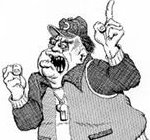
Why is everyone so uptight about proper spelling? It isn't really required for understanding.
Consider this paragraph:
Aoccdrnig to a rseearch at an Elingsh uinervtisy, it deosn't mttaer in waht oredr the ltteers in a wrod are, the olny iprmoetnt tihng is that the frist and lsat ltteer is at the rghit pclae. The rset can be a toatl mses and you can sitll raed it wouthit porbelm. Tihs is bcuseae we do not raed ervey lteter by itslef but the wrod as a wlohe.
Most people seem to be able to get most of the meaning all right without proper spelling. It's only in specific cases that spelling changes meaning. So why spell properly?
It's for credibility. If your writing is full of misspelled words, people will think you are an idiot, and they certainly won't pay much attention to your writing.
Next time we will look at some ways to make sure our writing is spelled correctly.
Wednesday, November 21, 2007


Monday, November 19, 2007
Writing for Style - Focused Freewriting
Freewriting is writing without rules. Start by jotting down the first thoughts that come to mind, no matter how trivial or disconnected they may appear.
You may eventually delete it or toss it away. But if you first read it over carefully, you might find a key word or phrase or maybe even a sentence or two that can be developed into a longer piece of writing. Freewriting may not always give you specific material for a future essay, but it will help you get into the right frame of mind for writing.
Focused Freewriting follows the same process but begins with a topic:
Most people need to practice freewriting several times before they are able to make it work for them effectively. So be patient.
Try freewriting as a regular exercise, perhaps three or four times a week, until you find that you can write without rules comfortably and productively.
You may eventually delete it or toss it away. But if you first read it over carefully, you might find a key word or phrase or maybe even a sentence or two that can be developed into a longer piece of writing. Freewriting may not always give you specific material for a future essay, but it will help you get into the right frame of mind for writing.
Focused Freewriting follows the same process but begins with a topic:
- Put a topic of your choice, or even the topic of your next paper, at the top of a blank page. Set a time limit and begin Freewriting.
- This time, write down things that seem to be related to the topic. Do not worry about order of ideas or grammatical correctness.
- Don't worry if the ideas seem to be digressions.
- When time is up, look over what you have written. Pull out ideas and phrases you can use later.
- Practice putting the Freewriting into outline form. If you were to use the writing to begin a paper, which points would you make first? Second?
Most people need to practice freewriting several times before they are able to make it work for them effectively. So be patient.
Try freewriting as a regular exercise, perhaps three or four times a week, until you find that you can write without rules comfortably and productively.
Friday, November 16, 2007
Writing for Style - Freewriting
Staring at a blank computer screen or piece of paper has to be one of the most awkward times for a writer.
Suddenly your desk needs tidying, then the books in the bookcase demand sorting into alphabetical order, then it’s time to check your email—anything is more attractive than writing.
Making something out of nothing, creating something that has never existed before, is akin to Dumbledore waving his wand to produce a feast for dozens of hungry students. It’s magic. If the prospect of having to make magic makes you uneasy, you are not alone.
It’s not that writers have nothing upstairs, its just that most of us have no special talent for organizing thoughts and putting them down on paper. So instead of writing, I just scribble. Then I go back and try to make sense of it all.
This scribbling is called freewriting—writing without rules. If you find yourself searching for a writing topic, start by jotting down the first thoughts that come to mind, no matter how trivial or disconnected they may appear. Freewriting resembles the warm up you might do before exercising. There is no "correct" way to do this, so try your own variation of these steps:
For five minutes, write non-stop: don't lift your fingers from the keyboard or your pen from the page. Just keep writing. Don't stop to ponder or make corrections or look up a word's meaning in the dictionary. Just keep writing.
Next time: Focused Freewriting
Suddenly your desk needs tidying, then the books in the bookcase demand sorting into alphabetical order, then it’s time to check your email—anything is more attractive than writing.
Making something out of nothing, creating something that has never existed before, is akin to Dumbledore waving his wand to produce a feast for dozens of hungry students. It’s magic. If the prospect of having to make magic makes you uneasy, you are not alone.
It’s not that writers have nothing upstairs, its just that most of us have no special talent for organizing thoughts and putting them down on paper. So instead of writing, I just scribble. Then I go back and try to make sense of it all.
This scribbling is called freewriting—writing without rules. If you find yourself searching for a writing topic, start by jotting down the first thoughts that come to mind, no matter how trivial or disconnected they may appear. Freewriting resembles the warm up you might do before exercising. There is no "correct" way to do this, so try your own variation of these steps:
- Begin with a blank computer screen or a pad and a watch (or the clock on the computer). Freewriting involves generating words, not correcting them or getting just the right word. Set a time for yourself.
- Try one, five, or ten minutes. Longer times may not be that productive since freewriting is a "warm up" for more focused writing.
- Begin to type or write about anything that comes into your head. Don't stop until the time is up.
- Then review what you have written. Are there words you like? Ideas that might work for your writing project?
For five minutes, write non-stop: don't lift your fingers from the keyboard or your pen from the page. Just keep writing. Don't stop to ponder or make corrections or look up a word's meaning in the dictionary. Just keep writing.
Next time: Focused Freewriting
Wednesday, November 14, 2007
Writing for Grammar: The Secrets of Nyms 2
More heteronyms, then capitonyms.
A heteronym (HET-uhr-uh-nim) is a word that has the same spelling as another word but with a different pronunciation and meaning. In a pure heteronymic pair, the two words must be etymologically unrelated, as in bass, buffet, deserts, dove, entrance, lead, moped, unionized, wind, and wound.
11) The insurance was invalid for the invalid.
12) There was a row among the oarsmen about how to row.
13) They were too close to the door to close it.
14) The buck does funny things when the does are present.
15) A seamstress and a sewer fell down into a sewer line.
16) To help with planting, the farmer taught his sow to sow.
17) The wind was too strong to wind the sail.
18) After a number of Novocain injections, my jaw got number.
19) Upon seeing the tear in the painting I shed a tear.
20) I had to subject the subject to a series of tests.
21) How can I intimate this to my most intimate friend?
22) I spent last evening evening out a pile of dirt.
A capitonym (KAP-i-toh-NIM) is a word that changes pronunciation and meaning when it is capitalized.
Job's Job
In August, an august patriarch
Was reading an ad in Reading, Mass.
Long-suffering Job secured a job
To polish piles of Polish brass.
Herb's Herbs
An herb store owner, name of Herb,
Moved to a rainier Mount Rainier.
It would have been so nice in Nice,
And even tangier in Tangier.
Next time: contronyms
A heteronym (HET-uhr-uh-nim) is a word that has the same spelling as another word but with a different pronunciation and meaning. In a pure heteronymic pair, the two words must be etymologically unrelated, as in bass, buffet, deserts, dove, entrance, lead, moped, unionized, wind, and wound.
11) The insurance was invalid for the invalid.
12) There was a row among the oarsmen about how to row.
13) They were too close to the door to close it.
14) The buck does funny things when the does are present.
15) A seamstress and a sewer fell down into a sewer line.
16) To help with planting, the farmer taught his sow to sow.
17) The wind was too strong to wind the sail.
18) After a number of Novocain injections, my jaw got number.
19) Upon seeing the tear in the painting I shed a tear.
20) I had to subject the subject to a series of tests.
21) How can I intimate this to my most intimate friend?
22) I spent last evening evening out a pile of dirt.
A capitonym (KAP-i-toh-NIM) is a word that changes pronunciation and meaning when it is capitalized.
Job's Job
In August, an august patriarch
Was reading an ad in Reading, Mass.
Long-suffering Job secured a job
To polish piles of Polish brass.
Herb's Herbs
An herb store owner, name of Herb,
Moved to a rainier Mount Rainier.
It would have been so nice in Nice,
And even tangier in Tangier.
Next time: contronyms
Tuesday, November 13, 2007
Writing for Grammar: The Secrets of Nyms
Most people are familiar with some of the nyms:
But there are also heteronyms, capitonyms, and contranyms.
A heteronym (HET-uhr-uh-nim) is a word that has the same spelling as another word but with a different pronunciation and meaning. In the following poem, each end-word is heteronymic:
Listen, readers, toward me bow.
Be friendly; do not draw the bow.
Please don't try to start a row.
Sit peacefully, all in a row.
Don't act like a big, fat sow.
Do not the seeds of discord sow.
In a pure heteronymic pair, the two words must be etymologically unrelated, as in bass, buffet, deserts, dove, entrance, lead, moped, unionized, wind, and wound.
1) The bandage was wound around the wound.
2) The farm was used to produce produce.
3) The dump was so full that it had to refuse more refuse.
4) We must polish the Polish furniture.
5) He could lead if he would get the lead out.
6) The soldier decided to desert his dessert in the desert.
7) Since there is no time like the present, he thought it was time to present the present.
8) At the Army base, a bass was painted on the head of a bass drum.
9) When shot at, the dove dove into the bushes.
10) I did not object to the object.
more nyms next time...
- synonyms - words that have similar meanings like sniff and inhale (but why isn’t there a synonym for the word synonym?)
- antonyms with opposite meanings like profit and loss
- homonyms - words that have the same sound and often the same spelling but differ in meaning, such as bank (embankment) and bank (place where money is kept).
But there are also heteronyms, capitonyms, and contranyms.
A heteronym (HET-uhr-uh-nim) is a word that has the same spelling as another word but with a different pronunciation and meaning. In the following poem, each end-word is heteronymic:
Listen, readers, toward me bow.
Be friendly; do not draw the bow.
Please don't try to start a row.
Sit peacefully, all in a row.
Don't act like a big, fat sow.
Do not the seeds of discord sow.
In a pure heteronymic pair, the two words must be etymologically unrelated, as in bass, buffet, deserts, dove, entrance, lead, moped, unionized, wind, and wound.
1) The bandage was wound around the wound.
2) The farm was used to produce produce.
3) The dump was so full that it had to refuse more refuse.
4) We must polish the Polish furniture.
5) He could lead if he would get the lead out.
6) The soldier decided to desert his dessert in the desert.
7) Since there is no time like the present, he thought it was time to present the present.
8) At the Army base, a bass was painted on the head of a bass drum.
9) When shot at, the dove dove into the bushes.
10) I did not object to the object.
more nyms next time...
Monday, November 12, 2007
Presentation Skills: Start With Something Interesting
Adapted from Wilder’s Presentations.
How do you begin your presentations? With your needs or the needs of your audience?
There is one guaranteed way to turn off an audience right from the start - by reading your agenda.
Here are five possible better ways to start:
How do you begin your presentations? With your needs or the needs of your audience?
There is one guaranteed way to turn off an audience right from the start - by reading your agenda.
Here are five possible better ways to start:
- Discuss three benefits the audience will receive by listening to you. "When you leave today you will have three things. First, you will go from frustration to ease of use with this program. Second, you will go from spending hours attempting to set up a meeting to just minutes. Third, you'll have more time to do your real work."
- Start with the three key messages you want your audience to remember and tell others. "Many of you here are not convinced that preventive healthcare should be taken seriously. I'm here to tell you that preventive health saves lives, reduces cost of care, and most importantly, enables people to live healthier, happier, and more productive lives."
- Provide a high-level summary of your talk. "Today we are looking at Project Talk. Right now the beta test shows some bugs in the system, and our desired outcome is to start advertising in six months. We looked at several strategies to reach that outcome, and concluded that we have to put more resources into moving Project Talk forward faster. Let me show you the rationale for this decision."
- A startling quotation or statistic: "In the 30 minutes it will take me to deliver this presentation, six children will die from hunger.”
- A story that summarizes the main point of your talk. “Twenty years ago, my friend Bob was homeless. He ate out of dumpsters and was always on the lookout for things he could steal and pawn…”
Tuesday, November 6, 2007
Writing for Style: Professional Emails
Adapted from Richard Nordquist at About Grammar.
E-mail is the most common form of written business communication - and the most commonly abused. Faced with an empty message screen, even a perfectly well-adjusted adult can turn abruptly into Dilbert's pointy-haired boss: "Teamwork is a lot of people doing what I say."
When 100 emails a day fill our mailbox, being concise counts.
Take a look at this e-mail message recently sent to all staff members on a large university campus:
It is time to renew your faculty/staff parking decals. New decals are required by Nov. 1, 2007. Parking Rules and Regulations require that all vehicles driven on campus must display the current decal.
Slapping a "Hi!" in front of this message doesn't solve the problem. It only adds an air of giddiness.
Instead, We can make this email nicer and shorter and probably more effective if we simply added a "please" and addressed the reader directly:
Please renew your faculty/staff parking decals by November 1.
Next, add how and where to renew. That's a professional email.
Quick Tips on Writing Professional E-mails
E-mail is the most common form of written business communication - and the most commonly abused. Faced with an empty message screen, even a perfectly well-adjusted adult can turn abruptly into Dilbert's pointy-haired boss: "Teamwork is a lot of people doing what I say."
When 100 emails a day fill our mailbox, being concise counts.
Take a look at this e-mail message recently sent to all staff members on a large university campus:
It is time to renew your faculty/staff parking decals. New decals are required by Nov. 1, 2007. Parking Rules and Regulations require that all vehicles driven on campus must display the current decal.
Slapping a "Hi!" in front of this message doesn't solve the problem. It only adds an air of giddiness.
Instead, We can make this email nicer and shorter and probably more effective if we simply added a "please" and addressed the reader directly:
Please renew your faculty/staff parking decals by November 1.
Next, add how and where to renew. That's a professional email.
Quick Tips on Writing Professional E-mails
- Always fill in the subject line with a topic that means something to your reader. Not "Decals" or "Important!" but "Deadline for New Parking Decals."
- Put your main point in the opening sentence. An e-mail shouldn't sound like Dickens.
- Never start a message with a vague "This." ("This needs to be done by 5:00.") Because most of us have to read dozens of e-mails a day, specify which "this" you're talking about.
- Don't use ALL CAPITALS (no shouting!). or all lower-case letters either (unless you're e. e. cummings).
- Remember to say "please" and "thank you." And mean it. "Thank you for understanding why afternoon breaks have been eliminated" is prissy and petty and mean. It's not polite.
- Edit and proofread before hitting "send." If your messages look like excerpts from a ten-year-old's chat room, don't be surprised if they're forwarded with a chortle to people you've never met.
- Finally, reply promptly to serious messages. If you need more than 24 hours to collect information or make a decision, send a brief response explaining the delay.
Wednesday, October 24, 2007
Writing for Fun - Irony 2
From Kerry Patterson at www.vitalsmarts.com
In Part 2, Kerry continues with his discussion of irony.
At first I was more than happy saying I couldn't remember the name of the dumb plant until it became clear that people treat individuals who can't remember the names of trees growing in their yard like some kind of drooling cretin who probably also doesn't know the size and brand of the tires on his car (I think mine are two ten, net thirty) and who as such, wouldn't have been able to bring down a woolly mammoth on his own and is really of no use to society.
It wasn't long until I starting taking a new tact. I made up names. For example, we selected the evergreen trees that grow next to my house because they grow tall and full, but not wide, so they wouldn't block the garage door. Now that they've grown to their full size, absolute strangers driving by my house slam on their brakes, knock on my door, and ask me about the trees in front of my house that grow tall, but remain skinny—because they need some just like them for their yard.
"Why those," I explain with a perfectly straight face, "are pynus anerexus and can be found at any nursery."
This lack of memory, it turns out, extends to plants I've known for over forty years. For reasons known only to the memory Gods, I can never recall the name of Petunias when I need to. Picking up on a technique I read in an article, I decided to try the association game. I associated the flower with an imaginary pig because the only other Petunia I knew was Petunia Pig, Porky Pig's girlfriend. Now I look at the flowers and think pig and call them Porkies.
Last summer I actually asked the lady at the local nursery for a flat of Wilburs. Growing increasingly concerned with the need to be able to recall the names of the plants in my yard, I committed to reading and memorizing the names of the annuals I put in each spring. After all, each little packet of six flowers comes with several white plastic sticks stating the name of whatever is growing in the container.
After planting a lovely blue flower, I just knew that people were going to ask me what it was called so I read the name, spelled it in my head, said it aloud several times, and made up a little song. Surely I'd remember the name of this beauty. Later that evening as I lay in bed replaying the events of the day in my mind, my thoughts turned to planting the new annuals and it struck me that I couldn't recall the name of the beautiful blue flowers I had planted next to my walkway.
What the heck were those things called anyway? The harder I tried the more my brain turned to mush until eventually I could take it no longer. In a fit of self loathing I grabbed a flashlight, put on flip-flops and a bathrobe, and at some time around one in the morning trudged out to find the silly blue flowers.
Seconds later I kneeled next to the flower bed, flashed my light around until I spotted a white stick with words printed on it, and pulled up eyeball-to-plastic stick until I could finally read the name of the flower I had—despite efforts to the contrary—completely forgotten. The name of the plant? "Forget-me-not."
So there you have it. If you're looking for a way to explain the meaning of irony to someone, I've now shared with you the perfect story. And please take the time to explain the real meaning of the word.
Continued abuse of the meaning would be absolutely heinous. Literally.
In Part 2, Kerry continues with his discussion of irony.
At first I was more than happy saying I couldn't remember the name of the dumb plant until it became clear that people treat individuals who can't remember the names of trees growing in their yard like some kind of drooling cretin who probably also doesn't know the size and brand of the tires on his car (I think mine are two ten, net thirty) and who as such, wouldn't have been able to bring down a woolly mammoth on his own and is really of no use to society.
It wasn't long until I starting taking a new tact. I made up names. For example, we selected the evergreen trees that grow next to my house because they grow tall and full, but not wide, so they wouldn't block the garage door. Now that they've grown to their full size, absolute strangers driving by my house slam on their brakes, knock on my door, and ask me about the trees in front of my house that grow tall, but remain skinny—because they need some just like them for their yard.
"Why those," I explain with a perfectly straight face, "are pynus anerexus and can be found at any nursery."
This lack of memory, it turns out, extends to plants I've known for over forty years. For reasons known only to the memory Gods, I can never recall the name of Petunias when I need to. Picking up on a technique I read in an article, I decided to try the association game. I associated the flower with an imaginary pig because the only other Petunia I knew was Petunia Pig, Porky Pig's girlfriend. Now I look at the flowers and think pig and call them Porkies.
Last summer I actually asked the lady at the local nursery for a flat of Wilburs. Growing increasingly concerned with the need to be able to recall the names of the plants in my yard, I committed to reading and memorizing the names of the annuals I put in each spring. After all, each little packet of six flowers comes with several white plastic sticks stating the name of whatever is growing in the container.
After planting a lovely blue flower, I just knew that people were going to ask me what it was called so I read the name, spelled it in my head, said it aloud several times, and made up a little song. Surely I'd remember the name of this beauty. Later that evening as I lay in bed replaying the events of the day in my mind, my thoughts turned to planting the new annuals and it struck me that I couldn't recall the name of the beautiful blue flowers I had planted next to my walkway.
What the heck were those things called anyway? The harder I tried the more my brain turned to mush until eventually I could take it no longer. In a fit of self loathing I grabbed a flashlight, put on flip-flops and a bathrobe, and at some time around one in the morning trudged out to find the silly blue flowers.
Seconds later I kneeled next to the flower bed, flashed my light around until I spotted a white stick with words printed on it, and pulled up eyeball-to-plastic stick until I could finally read the name of the flower I had—despite efforts to the contrary—completely forgotten. The name of the plant? "Forget-me-not."
So there you have it. If you're looking for a way to explain the meaning of irony to someone, I've now shared with you the perfect story. And please take the time to explain the real meaning of the word.
Continued abuse of the meaning would be absolutely heinous. Literally.
Tuesday, October 23, 2007
Writing for Fun - Irony 1
From Kerry Patterson at www.vitalsmarts.com
People are constantly misusing the word irony. That's right, grab your pitchforks, hot tar, and feathers and come join with me as I lead a counterassault on this growing threat.
This problem, as you may know, falls in the middle of an ugly onslaught of morphing words and degrading grammar—all of which are chipping away at the clarity of our communication. For example, teenagers in my neighborhood now use the word heinous (which means totally reprehensible, even abominable) to mean "out of fashion" or possibly "uncool." For example, I recently overheard the following sentence. "She carried a purse that was positively heinous."
Now, unless said purse was actually seen wielding a chain saw in a school bus, it probably wasn't one tiny bit heinous.
Some words have actually come to mean their exact opposite. People now use literally to mean "not literally." Once again, overheard in a shopping mall: "I ate so much at the buffet that I was literally two potato chips away from exploding." I doubt it.
The term ironic, which is rich in meaning and nuance, is routinely used to mean weird or paradoxical and that's a bit of a shame because the word means so much more. If you look irony up in the dictionary, you don't get much help. The most common meaning is: "surprising or unexpected," but that's much too broad an explanation.
"How's your dad?"
"Didn't you hear? He was hit by a truck and killed!"
"Really? How ironic."
Of course, none of this verbal confusion is of much import. These examples are not nearly as bad as the fact that flammable and inflammable both mean "flammable." Now there's a verbal mix-up of some potential consequence. Notwithstanding the triviality of the issue, I recently came up with such a wonderful tool for explaining the meaning of the word irony that I just have to tell the story.
It all started sixteen years ago when my wife and I bought the home we currently live in. The backyard of our new house consisted of a long, sloping stretch of lawn that was just terrific if you were a six-year-old who enjoyed rolling down the hill. My wife and I had other plans in mind, so we re-landscaped our entire yard. This included planting over two hundred trees and shrubs. As we chose between oak, red oak, flaming red oak, etc., I eventually became quite familiar with the names of all of our choices.
Unfortunately, as I continued my headlong plunge into senility, it wasn't long until I had forgotten the name of almost every choice of foliage. I didn't care a whit about this mental slippage until I discovered that people would look at our yard, like a particular tree or shrub, and then ask me for the name.
People are constantly misusing the word irony. That's right, grab your pitchforks, hot tar, and feathers and come join with me as I lead a counterassault on this growing threat.
This problem, as you may know, falls in the middle of an ugly onslaught of morphing words and degrading grammar—all of which are chipping away at the clarity of our communication. For example, teenagers in my neighborhood now use the word heinous (which means totally reprehensible, even abominable) to mean "out of fashion" or possibly "uncool." For example, I recently overheard the following sentence. "She carried a purse that was positively heinous."
Now, unless said purse was actually seen wielding a chain saw in a school bus, it probably wasn't one tiny bit heinous.
Some words have actually come to mean their exact opposite. People now use literally to mean "not literally." Once again, overheard in a shopping mall: "I ate so much at the buffet that I was literally two potato chips away from exploding." I doubt it.
The term ironic, which is rich in meaning and nuance, is routinely used to mean weird or paradoxical and that's a bit of a shame because the word means so much more. If you look irony up in the dictionary, you don't get much help. The most common meaning is: "surprising or unexpected," but that's much too broad an explanation.
"How's your dad?"
"Didn't you hear? He was hit by a truck and killed!"
"Really? How ironic."
Of course, none of this verbal confusion is of much import. These examples are not nearly as bad as the fact that flammable and inflammable both mean "flammable." Now there's a verbal mix-up of some potential consequence. Notwithstanding the triviality of the issue, I recently came up with such a wonderful tool for explaining the meaning of the word irony that I just have to tell the story.
It all started sixteen years ago when my wife and I bought the home we currently live in. The backyard of our new house consisted of a long, sloping stretch of lawn that was just terrific if you were a six-year-old who enjoyed rolling down the hill. My wife and I had other plans in mind, so we re-landscaped our entire yard. This included planting over two hundred trees and shrubs. As we chose between oak, red oak, flaming red oak, etc., I eventually became quite familiar with the names of all of our choices.
Unfortunately, as I continued my headlong plunge into senility, it wasn't long until I had forgotten the name of almost every choice of foliage. I didn't care a whit about this mental slippage until I discovered that people would look at our yard, like a particular tree or shrub, and then ask me for the name.
Saturday, October 20, 2007
Writing for Style: Words About Words
I'm astonished that I've let half of October go without any posts. Teaching, private clients, a car accident that totaled our car, researching new cars, and finally deciding on a Prius have consumed us.
Anyway, here are some words about words, courtesy of Richard Nordquist at About.com. You can find them in the second edition of the complete (20-volume) Oxford English Dictionary. You may have trouble slipping them into conversation, buy may be able to use them in an email to a fellow logophile
amphigouri (also spelled amphigory)
A "composition without sense," according to the Oxford English Dictionary. Writing that at first may appear to mean something--but upon closer study proves to be meaningless.
battology
A needless and tiresome repetition in speaking or writing.
cheville
A meaningless or redundant word or phrase inserted to round off a sentence or complete a verse.
grammatolatry
The worship of words. A grammatolator is a stickler for the forms of words.
idioglossia
Invented speech, a private language. According to the OED, "a form of dyslalia [or speech impairment] in which the person affected consistently makes substitutions in his speech sounds to such an extent that he seems to speak a language of his own."
logodaedaly
"Cunning in words," according to the Oxford English Dictionary, or "skill in adorning a speech." However, the Merriam-Webster Unabridged Dictionary defines it less favorably as "the arbitrary or capricious coinage of words."
logomachy
A disagreement about words and their meanings.
orthoepy
The branch of linguistics that deals with pronunciation. Interestingly, some orthoepists pronounce the term with an emphasis on the or while others stress the tho.
rumbelow
A meaningless combination of syllables serving as a refrain, such as the sounds "yo ho ho" and "hey ho" of rowing sailors.
xenoglossia
Speaking or writing in a known language that one has never studied or learned (at least not in any perceivably normal way).
Anyway, here are some words about words, courtesy of Richard Nordquist at About.com. You can find them in the second edition of the complete (20-volume) Oxford English Dictionary. You may have trouble slipping them into conversation, buy may be able to use them in an email to a fellow logophile
amphigouri (also spelled amphigory)
A "composition without sense," according to the Oxford English Dictionary. Writing that at first may appear to mean something--but upon closer study proves to be meaningless.
battology
A needless and tiresome repetition in speaking or writing.
cheville
A meaningless or redundant word or phrase inserted to round off a sentence or complete a verse.
grammatolatry
The worship of words. A grammatolator is a stickler for the forms of words.
idioglossia
Invented speech, a private language. According to the OED, "a form of dyslalia [or speech impairment] in which the person affected consistently makes substitutions in his speech sounds to such an extent that he seems to speak a language of his own."
logodaedaly
"Cunning in words," according to the Oxford English Dictionary, or "skill in adorning a speech." However, the Merriam-Webster Unabridged Dictionary defines it less favorably as "the arbitrary or capricious coinage of words."
logomachy
A disagreement about words and their meanings.
orthoepy
The branch of linguistics that deals with pronunciation. Interestingly, some orthoepists pronounce the term with an emphasis on the or while others stress the tho.
rumbelow
A meaningless combination of syllables serving as a refrain, such as the sounds "yo ho ho" and "hey ho" of rowing sailors.
xenoglossia
Speaking or writing in a known language that one has never studied or learned (at least not in any perceivably normal way).
Subscribe to:
Comments (Atom)